2025: A RetroSPECtive

Happy new year! 2026 is here, but no doubt I will keep accidentally writing 2025 until at least March.

2025 was the most pivotal year of my writer career so far. So here’s a final send-off (it’s a retroSPECtive, as in speculative fiction, get it? …I’ll see myself out) and a final review of the year.

May 28: Release of All the Broken Blades

My first book! I can finally say, “I’m an author, check out my book!” (versus “I’m an author, please comb the back issues of XYZ magazine”). Following a successful Kickstarter, I released All the Broken Blades on May 28.

I learned a lot in the process, including:

  • ISBNs and how to find get them
  • All the different ebook platforms
  • Amazon KDP and IngramSpark
  • P.O. Box adventures
  • Working with two incredible artists on the book cover (Lana Kamaric for the illustration and Tony Sahara for the cover design)
  • Interior layout (thank goodness for Atticus)
  • Pesky typos remain even after 23479473928 rounds of editing (shout out to Justin Dill for last minute proofreading)
  • Everything takes longer than you think

This was my first time independently releasing my work; I previously wrote stories, sold stories, (thankfully) got paid, and someone else handled the rest. Perhaps I will make a post on the one-year anniversary of the book with a step-by-step of how I produced and released All the Broken Blades? Stay tuned.

Reading/storytelling session at the Imperial Pub book launch party.

I also held two launch parties: one at the dearly departed Imperial Pub, and one at North America’s oldest science fiction and fantasy bookstore Bakka-Phoenix. These were followed by a book signing at Indigo Books, Canada’s largest bookstore chain.

August 10: Two-time Aurora Award Winner? Moi?

The Aurora Awards in their boxes.

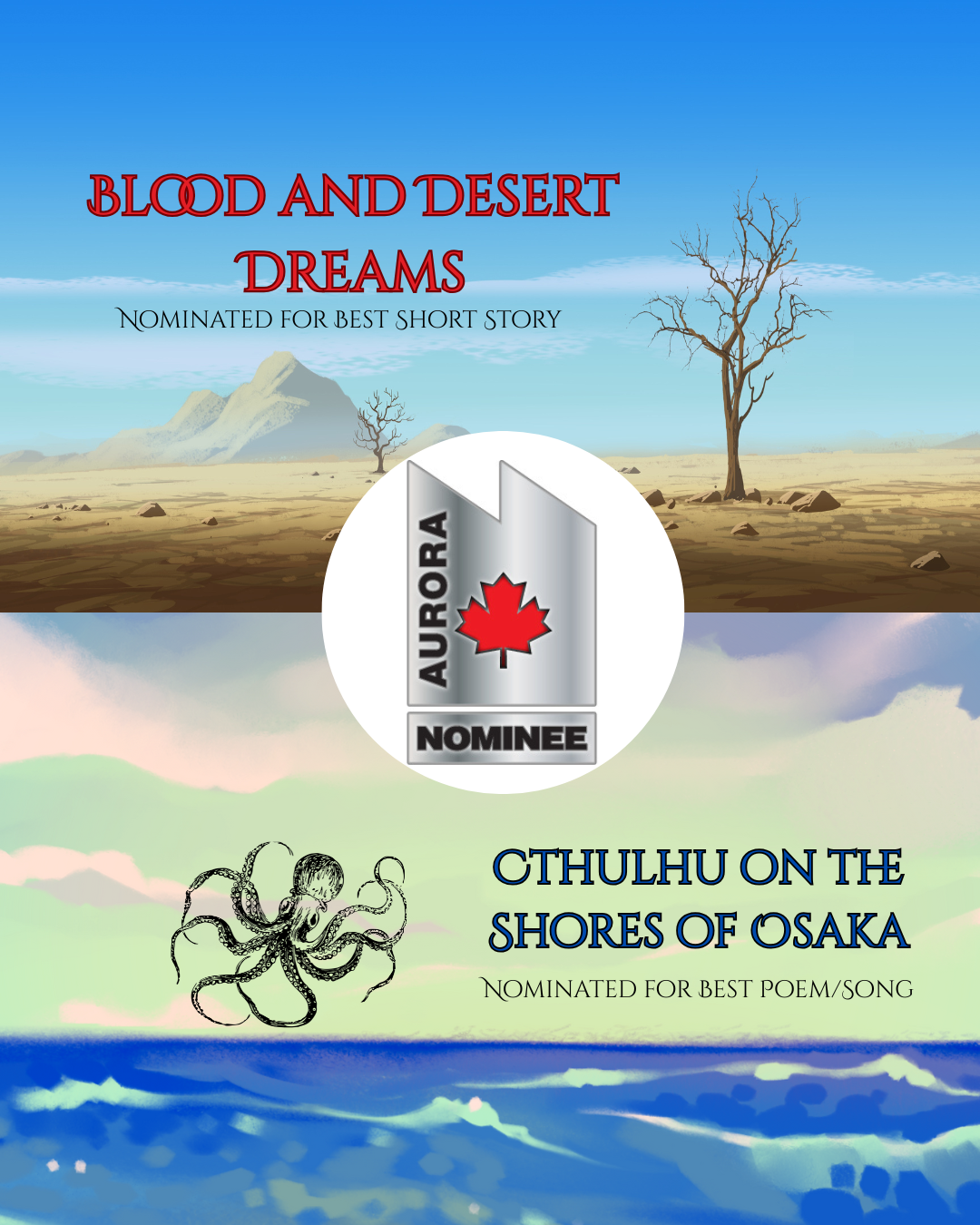
Third time’s the charm and fourth time’s the double charm? Truly, it was an honour to be nominated again, and in two different categories to boot. Actually winning both was…

Dreamy. Strange. Wonderful and confusing.

I had takoyaki ready for the Best Poem/Song announcement; the poem is called “Cthulhu on the Shores of Osaka,” so you can guess what happened to poor Cthulhu. By the Best Short Story announcement (in which “Blood and Desert Dreams” won), I was out of ideas for a funny speech and had deteriorated to denying bubble tea shop sponsorship.

September 27-28: Word on the Street! First Literary Festival!

The Toronto Science Fiction and Fantasy Writers booth at Word on the Street, featuring the attending authors.

I attended Word on the Street as a vendor for the first time this year. My book was displayed at the Toronto Science Fiction and Fantasy Writers booth (special thanks to James Downe for organizing). Sales went well and I managed to not run away screaming (my default reaction to anywhere with crowds), so I consider it a worthwhile weekend!

October 17-18: Returning to Can*Con & Moderating

This was my third Can*Con, my second one as a panellist, and my first *gulp* as a moderator. Here is the thing with moderation: you actually need to prepare, while a panellist can show up and hope they sound smart for an hour. As someone who spent my school days with questionable studying habits and a tendency to not complete homework, I… am happy to report I actually performed some research and prepared questions beforehand. Were they smart questions? Eh.

The Toronto Science Fiction and Fantasy Writers vendor table at Can*Con

The new Brookstreet Hotel location was chaotic than the old Sheraton location. I grabbed a vendor table for the Toronto Science Fiction and Fantasy Writers (our second vendor table of the year), which also made for a nice landing spot for the group. A couple of us rented an AirBnB rather than staying at the hotel, creating nice memories of cooking together (by which I mean other people cooked and I ate).

I participated on three panels:

  • Hooking the Reader: Breaking Down What Works – All about story openings. I read a passage from “Blood and Desert Dreams.”
  • No Story Left Behind: The Ups and Downs of Submitting Short Fiction – I discussed the current state of the short fiction field.
  • And of course… The Continuation of Epic Fantasy – My moderation assignment, in which the panellists discussed the current status of epic fantasy, and what it meant to write it in the year of 2025. Which, interestingly, leads to my next topic…

November 19: (Not So) Secret Novel?

On November 19, I sent an important email. It was not a story submission. It was not about a conference or festival. It was not to announce my imminent plans to start a takoyaki-and-bubble-tea shop.

It was to send the edited draft of my (dark, epic) fantasy novel to beta readers.

I’ve been writing novels on-and-off since I was around fifteen. I’ve accumulated half-written novels, written-into-a-hot-mess novels, too-long-to-sell novels, 80,000-word-act-one novels, NaNoWriMo novels that were technically 50,000-word successes but didn’t even scratch a quarter of the plot, and everything in between. This is the first time where I’m like, hey, this is finished and maybe—just maybe—only 50% chimeric monstrosity. Time will tell, but maybe—just maybe—I’ll have a novel ready for querying in 2026?

2025 Aurora Award Wins: Best Short Story & Best Poem/Song!

I was all ready to walk around my next convention with a “4-time Aurora Award Loser” badge, but then…


I got a double-win instead?! Here is the official announcement.

  • “Cthulhu on the Shores of Osaka” won Best Poem/Song
  • “Blood and Desert Dreams” won Best Short Story

Huge thanks to the editors who published me over the years, the writing groups who asserted positive peer pressure, and the friends who believed in me even when I was thoroughly sick of my own writing.

You can watch a replay of the livestream here. My speeches are at 59:25 and 1:09:51. Warning: I used up my good jokes the first time around.

Oh, and I got a brief mention on CBC, which is just… wow.

“Cthulhu on the Shores of Osaka” – Winner of Best Poem/Song

Picture of the 2025 Aurora Award for Best Poem/Song, awarded to Y.M. Pang for "Cthulhu on the Shores of Osaka."
Yes, there’s a physical award with my name on it! This is the Best Poem/Song award for “Cthulhu on the Shores of Osaka.”

I’ve threatened to write a Cthulhu takoyaki story for years. When I learned that Cthulhu was basically a giant octopus, my first thought was, “Ah, food!” Maybe, depending on where he washes ashore, people may not gaze upon him with awe or fear, or even with scientific reverence. They may well witness the one-and-only eldritch god (an endangered species if there ever was one) and decide he makes a good meal.

Takoyaki–fried octopus balls–is a Japanese street food that originated in Osaka. It’s enjoyed all over the world now, though name is bit misleading–most of the snack is the batter, with only a tiny tendril of octopus tentacle inside.

So why not turn a horrifying and unknowable deity into a snack ingredient, basically the side dish of a side dish? Thus was the birth of “Cthulhu on the Shores of Osaka.”

I wrote this poem in a single day as part of Toronto Science Fiction and Fantasy Writers’ annual one-shot anthology series (participants must write their pieces within the span of 24 hours, and the works are compiled in a book after). The editing mostly consisted of debating someone about the exact pH of stomach acid.

This one-shot writing challenge has spawned many of my works over the years; some stories I initially drafted during the challenge but choose not to include them in the one-shot anthologies, instead editing them past the 24-hour period and publishing the works elsewhere.

“Blood and Desert Dreams” – Winner of Best Short Story

And here is the Best Short Story award for “Blood and Desert Dreams.” To my surprise, both awards came with the announcement envelope–I didn’t realize I’d be the one to keep those!

Speaking of which, “Blood and Desert Dreams” was originally drafted during a one-shot writing challenge. I did get the story done in a day, but soon after I received an invitation from a previous editor to submit to his magazine.

I opted to not include “Blood and Desert Dreams” in the Legacy one-shot anthology, thinking it might be a good fit for the magazine that published me before. Alas, after heavy consideration, the editor… didn’t end up buying my story.

But Scott H. Andrews at Beneath Ceaseless Skies did! We worked through multiple rounds of editing to create the version before you today, which is quite different from what I had the night of the one-shot anthology. “Blood and Desert Dreams” was once even more ambiguous, if you can believe that. Scott respected my vision of the unreliable narrator and “unique” ending (trying to not spoil anything), but he found ways to make the concept clearer. I did not want to mould the ending into a singular entity that it wasn’t, but Scott’s ideas preserved my vision while also making it palatable.

When award and “year’s best” compilation season hit, I experienced mixed feelings. “Blood and Desert Dreams” was my favourite among the three stories I published last year, but should I really ask people to consider it for year’s best anthologies or awards? It is ambitious, sure, and very representative of my writing. But I kept having flashbacks to early reader and editor feedback, about how difficult it was to understand. Had Scott’s edits been enough to broaden the appeal? Could there even be a broad appeal to a story with “that” ending?

The story has now been selected for the Year’s Best Canadian Fantasy and Science Fiction: Volume 3, and is the winner of an Aurora Award. I guess my doubts were unfounded.

Photo of author Y.M. Pang the 2025 Aurora Awards.
The Aurora Awards in their natural habitat, or so I pretend. Truth is, this isn’t even my house and I’m still figuring out where to display them…

What’s next? I’m still hard at work on my dark fantasy novel. Day job is still running interference (don’t get me wrong–I love my day job; it just consumes a lot of my time). I’ll be attending Word on the Street (Toronto) and Can*Con (Ottawa). And at some point, I will turn my gaze to that second short story collection, because the science fiction and urban fantasy also deserve their forever homes.

In the meantime: stay hydrated, watch this space for announcements, and don’t forget to devour all your cosmic horrors!

Interview with Don Miasek: Science Fiction Writer & Aurora Award Finalist

In a first for this blog, Ive had the pleasure of interviewing a guest: science fiction writer Don Miasek. Dons debut novel Pale Grey Dot is on the ballot for Best Novel at the Aurora Awards for Canadian science fiction and fantasy, and I’m very curious about what he has to say regarding the awards and his novel.

Book cover of Pale Grey Dot by Don Miasek.

Aurora Award finalist—how does that title feel?

Quite nice! Technically this is my second time—Strange Wars was on the Best Related Work ballot back in 2023, but that was for editing an anthology, so any recognition there is just me stealing from the authors.

As for Pale Grey Dot, I am quite proud it’s being recognized. It’s my baby, and a lot of hard work went into it. It’s also a testament to the help I’ve had from my editors and beta readers.

Book cover of Strange Wars, a speculative fiction anthology edited by Don Miasek.

The main thing that struck me about Pale Grey Dot is the focus on character and found family relationships—not necessarily what the science fiction genre is famous for. Is there a reason you opted to write a more character-driven science fiction story?

I’m always baffled by sci-fi not being character driven. Ok, sure, the sci-fi concepts are going to be front-and-centre, but why not both?

I want the reader to fall in love with the characters just as much as the sci-fi world. Their relationship drives the story. If they didn’t love each other so much, all motivation is gone.

I also wanted contrast between the characters. Jenna is the vicious rebel, Ezza is the prim-and-proper authority figure, and Cherny is somewhere in the middle. I fixated on the idea of them suffering the same setback—being fired after a mission gone horribly wrong—and each reacting to it in entirely different ways. Who is at fault for the disastrous Martian Insurrection? Ezza, Cherny, and Jenna offer opposing viewpoints.

I’m also a fan of taking different characters, making them all likeable, and then pitting them against one another. Each have good reasons for doing what they do. They’re justified in their own mind. This creates a wonderful nuance, where you learn what each character values. It also helps to drive up tension, since you know they can’t all win.

People often talk about “hard” science fiction vs. “soft” science fiction. Where would you say Pale Grey Dot falls on the scale?

Sci-fi hardness tends to fall in two categories:
1. Things people already know, and therefore only requires the author to adhere to it
2. Science that only 1% of the population will understand, and is therefore indistinguishable from being made up nonsense

For example, everyone knows there is no weight in space. If you have Kirk walk across the bridge with artificial gravity, you know that isn’t realistic. It’s a stylistic choice by Gene Roddenberry. For Pale Grey Dot, I decided to obey physics. That means characters float in their spaceships, need to clip themselves into railings to hold still, and can only walk when the ship is rotating. I did not have to explain to the reader how gravity works. I only needed to make it clear that I was going to be realistic about it.

On the other hand, ships in the Pale Grey Dot universe use nuclear pulse engines. This is a real theoretical method of propulsion, but I could have picked an ion drive, or impulse engines, or a transfusic flux phase-capacitor actuator. Nothing in the book would have changed if I went with gobbledygook, and the reader doesn’t need to know how it works. It’s the engine. It makes the ship go! Lesson complete.

Pale Grey Dot is hard on #1, but as I like to say, it’s “Accessibly Hard Science Fiction”.

Photo of Don’s extremely successful launch party at Bakka-Phoenix Books.

Among the three point-of-view characters—Cherny, Ezza, and Jenna—do you have a personal favourite? Who was the most fun to write, the most difficult to write, and/or the most relatable for you?

I love all my characters!

That said, Jenna was the most fun to write. As mentioned above, I wanted a contrast between the characters, and Jenna is the one who finds herself in dilapidated cyberpunk slums, cheap motel rooms with mould growing on the walls, and broken down spaceships. She’s desperate, she’s hungry, she’s pissed, and she’s willing to do whatever it takes to win. I could write that all day long!

Ezza, on the other hand, spends most of her time in civilization. Her warship, Starknight, is well run. It’s clean, it’s efficient, and the crew are capable. She can also be counted on to do the right thing. This is great since it highlights Jenna’s desperation, but it risks making Ezza boring. I had to work extra hard to make the environments and setpieces interesting, and to ensure she wai properly challenged. I gotta make my characters suffer, and because Ezza is so damn competent, I needed to REALLY make her suffer.

Cherny, as usual, was somewhere in between. He spends some time in the slums, and some time in civilization. The big draw of writing him was that he’s the one who has a tough decision to make. Jenna ain’t going to join the Earth Security Service. Ezza is also going to resist it. But my boy Cherny? He’s truly, genuinely tempted. I wanted the reader to see the upside of joining, both for Cherny personally, and also for the solar system as a whole. What will he choose? Gotta read to find out!

Don signing books at his launch party. He wrote a retrospective about the experience on his blog for the one-year anniversary of Pale Grey Dot.

Another theme in Pale Grey Dot is conflicting loyalties: lingering loyalty to Her (whether real or artificial) vs. loyalty to the other Athena Six vs. consideration for the rest of the Solar System. How do the three main characters differ in terms of where their loyalties lie?

This goes back to making your characters suffer. That isn’t just physical suffering, but emotional as well. An easy way to do that is to give ‘em a dilemma—a situation where they must choose between two things they desire. Does Cherny want to stay with Her and live the wonderful life of an operative? Or does he want to rejoin his fellow Athena Sixers? Naturally, he tries to have both, but the story punishes him for his wishy-washiness. Sorry, Cherny, you must pick one or the other. No matter what, someone will be hurt by your decision.

Even Jenna and Ezza, who are a bit more consistent in their loyalties, have to make tough calls. Is Jenna willing to hurt innocents in her quest for vengeance? Is Ezza willing to dive back into the murky waters of the Earth Security Service, even if it puts her beloved United Fleet at risk?

The concept of Her (Karla) is fascinating, with how huge an impact She has despite minimal physical presence on the page. Could you describe how you conceptualized Her, and whether there were any changes in different drafts of the book?

I think She might be my biggest success. Even deciding to capitalize Her was a risk that easily could have backfired. Would the reader ever get confused between Her and any ol’ her? Would the reader wonder how the characters know someone is talking about Her when it’s in dialog? I had to be extremely careful to ensure it all worked. Heck, I wrote “I think” at the beginning of this answer strictly so She would appear in the middle of the sentence, and therefore the capitalization would stand out.

Beyond grammar, I had a lot of fun with Her personality. She’s a character of contradictions. She emotionally abuses her ‘children’, yet she’s willing to go out on a limb to protect them. She fights tooth and nail to keep them safe, yet She’ll discard them if need be. Does She truly love Her agents? Does She want what’s best for them? Jenna, Cherny, and Ezza have totally opposing opinions on this, and I want the reader to make up their own.

In addition, She was a great hook. A driving question I wanted in the reader’s head was just what was Her nature. Is she human? An AI? A whole team of people? Gotta keep reading to find out!

To my happy surprise, She exceeded my wildest dreams.

What’s next for you? Will we be seeing more stories in this universe?

There actually already is another story in the Pale Grey Universe. “For the Flesh and the Machine” was published in Polar Borealis back in December 2021, years before Pale Grey Dot hit the shelves. So if you’re interested in a little Jenna story before the events of the main book, check it out.

To answer your question about the future, stay tuned. The Pale Grey story has only just begun…


Note from Y.M. Pang: The deadline to register to vote for the Aurora Awards is fast approaching! If you are a Canadian citizen or permanent resident: you can become a voting member for the bargain price of $10. This gives you access to all the nominated works, including 10 novels (featuring Don’s novel Pale Grey Dot), 5 short stories (featuring my story “Blood and Desert Dreams”), 5 novelettes/novellas, and 5 poems (featuring my poem “Cthulhu on the Shores of Osaka”).

Deadlines:

  • July 12 – Membership payments close, Voters’ package download closes
  • July 19 – Aurora Awards voting closes

Aurora Awards 2025 – Voting Opens! (+ All the Broken Blades Book Launch)

Voting for the Aurora Awards for Canadian Science Fiction and Fantasy opened June 7, 2025. As you may (or may not) have heard, I have not one but two works on the shortlist:

Both these pieces are available to read online for free (just follow the links above).

If you are a Canadian citizen or landed immigrant: it’s not too late to grab your membership. Cost is just $10, and grants you access to a voters’ package containing all the nominated works—including five novels in the Best Novel category (don’t miss out this chance to read Pale Grey Dot by my colleague and friend Don Miasek—a truly excellent science fiction novel that blends classic starship fights with surprising character complexity).

Full Aurora Award dates:

  • June 7 – Aurora Awards voting opens
  • July 12 – Membership payments close, voters’ package download closes
  • July 19 – Aurora Awards voting closes
  • August 9 – Aurora Awards ceremony (online)

It’s a huge honour to be able to call myself a four-time Aurora Award finalist. Whether I win or not, I’m glad that these awards exist to bring awareness to Canadian science fiction and fantasy. And hey, four-time Aurora Award loser at least sounds hilarious, and I don’t let anything get in the way of a good laugh.

All the Broken Blades – Book Launch

The book launch for All the Broken Blades occurred on June 8, 2025 at the Imperial Pub. I had a full house (yay!), a wonderful host in Peter G. Reynolds, give-aways, a special oral storytelling version of “Glass Gardens,” and a trivia session where people fought over broken and unbroken swords.

If you’ve had a chance to read All the Broken Blades: an honest review on Goodreads, Amazon, Indigo, and/or your platform of choice would be appreciated!